
Table of Contents
- Why High Quality Cotton Feels and Performs Differently
- Long-Staple Cotton Benefits: Why Fibre Length Decides Everything
- The Touch, Feel, and Visual Tests for High Quality Cotton
- How to Perform a Cotton Burn Test at Home
- Post-Wash Performance: The Test Most Shoppers Skip
- Sustainable Cotton Certifications Worth Trusting
- Frequently Asked Questions
Last Updated: September 1, 2026
Why High Quality Cotton Feels and Performs Differently
According to the Cotton Council International and Cotton Incorporated's Global Lifestyle Monitor survey, 79% of UK consumers prefer cotton, cotton blends, and denim over other fabrics, and 73% plan to invest in higher-quality, longer-lasting pieces in 2026. High quality cotton is defined by measurable fibre characteristics, staple length, fineness, and tensile strength, that determine how a finished garment looks, feels, and wears over time. A study by the University of Leeds Institute of Textiles and Colour found that price is no reliable guide to t-shirt durability, with heavier-weight cottons and blends consistently outperforming cheaper lightweight options regardless of cost.
The difference shows up in three ways that matter to the wearer: softness that holds after repeated washing, structural integrity that resists pilling and distortion, and colour that stays true rather than bleeding or fading. Below, we'll walk through exactly how to assess each of these, using both hands-on tests you can do at home and technical markers worth knowing before you buy.
Long-Staple Cotton Benefits: Why Fibre Length Decides Everything
Fibre length is the single most important factor in cotton quality. Longer fibres create stronger, smoother yarn with fewer exposed fibre ends, which translates directly to softer hand-feel, greater durability, and dramatically less pilling over time. According to Cotton Inc. Textile Research, Fiber Quality Study, longer staple cotton fibres can increase yarn strength by up to 25% compared with shorter staple alternatives.
"Good-quality cotton has longer fibres than a cheaper quality. Longer fibres create a smooth surface without loose furry fibres poking out." -- Dr Georgia McCorkill, Fashion Lecturer at RMIT (The Guardian, 2023)
Short-staple cotton, typically under 25mm, produces a slightly rough, fuzzier yarn. Standard cotton from most mass-market garments falls into this category. Long-staple cotton, running from roughly 28mm to 34mm, produces a noticeably smoother, stronger fabric. The real difference becomes clear after the sixth or seventh wash, when short-staple fabric begins to pill and long-staple fabric remains largely unchanged.
Identifying Extra-Long Staple (ELS) Cotton
Extra-Long Staple cotton is the benchmark for premium textiles. ELS fibres measure 35mm or longer; the International Cotton Advisory Committee reports that ELS cotton constitutes less than 3% of global cotton production, which explains both its quality and its relative cost. Egyptian Giza and Pima are the most recognised ELS varieties.

ELS cotton holds a dominant 32.6% share of the premium end of the global cotton fibre market in 2026, driven by its superior softness, exceptional durability, and greater fabric strength. For consumers, the practical implication is straightforward: if a label says "Egyptian cotton" or "Pima cotton," the claim is worth investigating further. Genuine ELS garments will feel noticeably silkier and will drape differently from standard cotton.
Measurable Quality Markers: Micronaire, Tensile Strength, and GSM
Three technical measurements define raw cotton quality in textile manufacturing.
Micronaire measures fibre fineness and maturity. Optimal values sit between 3.7 and 4.2; below that range the fibre is too fine and prone to breakage; above it, the fabric feels coarser.
Tensile strength measures how much force a fibre can withstand before breaking. High-quality cotton fibres typically exhibit tensile strength exceeding 28 grams per tex. Higher tensile strength means the finished fabric resists tearing and maintains its shape under stress.
GSM, grams per square metre, is the most consumer-accessible metric. Lightweight tees at 130-150 GSM feel airy but wear thin quickly. Mid-weight fabrics at 180-220 GSM offer a better balance of comfort and longevity. Anything above 250 GSM is considered heavyweight and will hold its structure through sustained wear and washing. The University of Leeds study confirmed that heavier-weight cotton t-shirts consistently outperform lightweight versions in durability testing.
| Quality Marker | Standard Cotton | Long-Staple Cotton | ELS Cotton |
|---|---|---|---|
| Staple length | Under 25mm | 28-34mm | 35mm+ |
| Typical GSM | 130-160 | 160-220 | 180-260+ |
| Pilling resistance | Low | Moderate | High |
| Post-wash softness | Degrades quickly | Holds reasonably | Holds well |
| Best for | Budget basics | Everyday wear | Premium garments |
The Touch, Feel, and Visual Tests for High Quality Cotton
The most immediate way to assess cotton quality is through direct sensory analysis. Textile brokers in the early 19th century would pull fibres to judge length and rub them against their skin to assess fineness. That instinct remains valid.
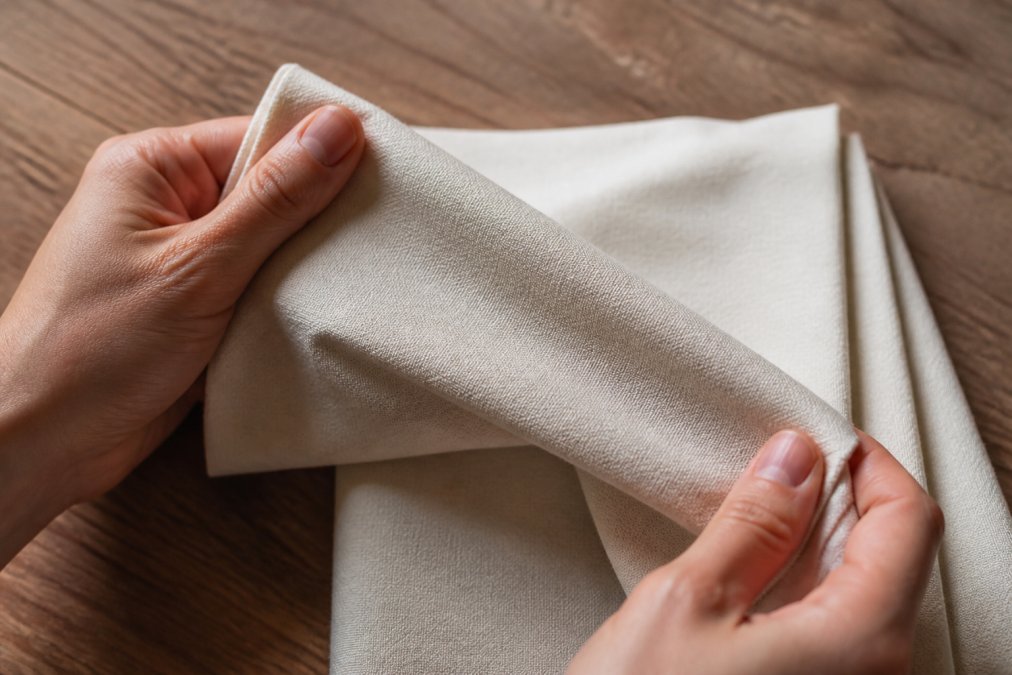
Hand-Feel and Drape
High quality cotton feels smooth and slightly cool to the touch, with a subtle weight that suggests density. Rub the fabric between your fingers: premium long-staple cotton will feel almost silky, without the slight scratchiness of short-staple alternatives. Gently stretch the fabric and release it; quality weaves spring back cleanly, while lower-quality cotton distorts or stays pulled.
Hold a section of fabric by one corner and let it fall. Good cotton drapes fluidly with a slight natural hang. Cheap blends or low-density weaves either stiffen artificially or collapse without body. Mercerised cotton, treated with sodium hydroxide to improve lustre and strength, has a particularly distinctive drape and subtle sheen worth recognising.
Weave Density, Thread Count, and Yarn Irregularity
Weave density refers to how tightly the yarns are packed together and directly affects durability and breathability. Hold the fabric up to light: a tight, even weave will allow very little light through. Loose weaves look more open and tend to distort under stress.
Thread count matters most in woven fabrics like shirting and bedding, where a higher count generally indicates finer yarn and tighter construction. For knitted fabrics like t-shirts, GSM is the more relevant metric. Look for consistency; yarn irregularity, where thickness varies noticeably across the fabric, signals lower-quality spinning and leads to uneven wear and patchy dye uptake.
Colour Fastness and Dye Quality
Colour fastness is one of the most reliable indicators of textile quality. Poor dye quality shows up fast: colours that bleed in the first wash, fading that happens unevenly, or a slightly chalky surface finish that rubs off on other fabrics.
Before buying, look at the seams and inside the hem. If the colour is noticeably paler on the interior, the dye has only partially penetrated the fibre, a sign of low-quality dyeing. Garment-dyed pieces tend to have a more lived-in, consistent finish that ages well rather than fading unevenly.
How to Perform a Cotton Burn Test at Home
The burn test is the most reliable at-home method for verifying fibre content and distinguishing pure cotton from synthetic blends. It takes less than a minute and requires only a small fabric swatch and a lighter.
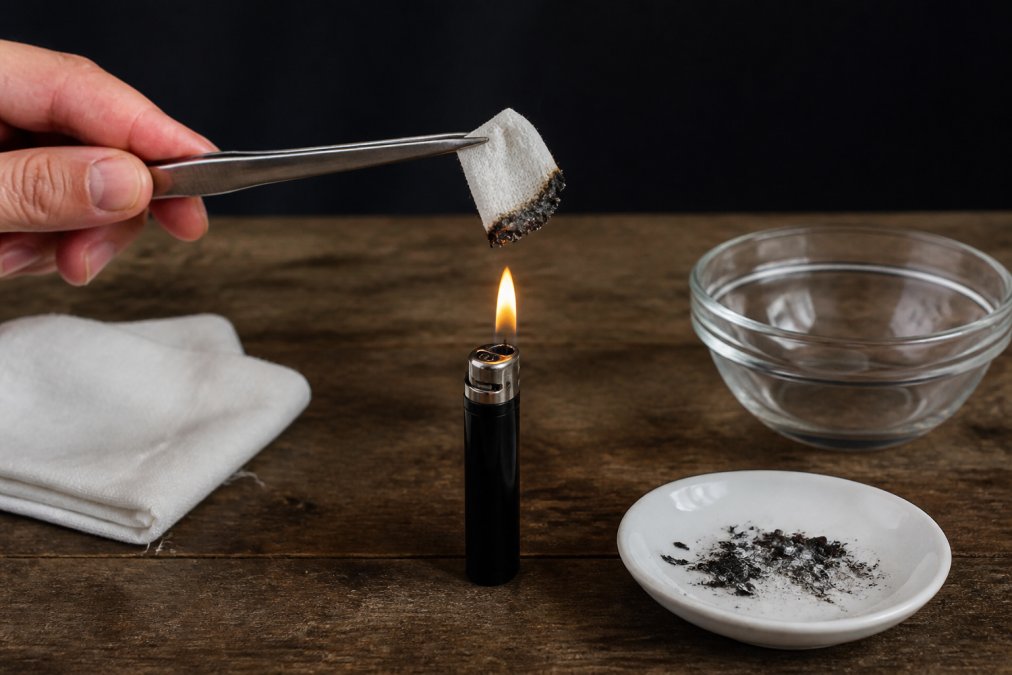
Here is how to perform a cotton burn test correctly:
- Cut a small swatch from an inconspicuous seam allowance, about 1cm square.
- Hold it with metal tongs or tweezers, never bare fingers.
- Bring it close to a flame and observe how it ignites.
- Note the smell, the burn behaviour, and the ash residue.
- Allow the ash to cool completely before handling.
What pure cotton does: Cotton ignites quickly and burns steadily, similar to paper. The smell is clean and slightly papery, not chemical or acrid. The ash residue is soft, grey, and crushes easily between your fingers.
What synthetic blends do: Polyester-cotton mixes melt and bead at the edges rather than burning cleanly. The smell is distinctly chemical or plastic. The residue is hard, black, and forms small beads that don't crush.
What this tells you: A garment labelled as 100% cotton that produces hard, melted residue contains synthetic fibres. This isn't always a problem, blends often improve durability and reduce shrinkage, but it matters if you're paying for pure cotton or buying for skin sensitivity reasons.
Post-Wash Performance: The Test Most Shoppers Skip
Most quality assessments happen before purchase. The real test happens after the third wash. Post-wash performance is where high quality cotton separates from everything else.
What to observe after the first three washes:
- Shrinkage: Some shrinkage in the first wash is normal for untreated cotton. More than 5% across multiple washes suggests low-quality or unsanforised fabric. Pre-shrunk or sanforised cotton should hold its dimensions reliably.
- Pilling: Pilling appears first at friction points like underarms and collars. Long-staple and ELS cotton resists pilling significantly better than short-staple alternatives. Heavy pilling after two or three washes is a definitive sign of short-staple or low-grade yarn.
- Colour retention: Premium cotton dyed with quality pigments should hold its colour through repeated washing at 30-40°C. Uneven fading or colour that bleeds onto other garments points to poor dye quality.
- Shape retention: A well-constructed cotton garment recovers its shape after washing and drying. Distortion around the neckline or hem after a few cycles indicates inadequate fabric weight or poor seam construction.
Sustainable Cotton Certifications Worth Trusting
The organic cotton market has a documented integrity problem. Less than 1% of global cotton production is certified organic, yet a far greater volume of "organic cotton" products reaches shelves each year. Brands frequently blend organic and conventional cotton while prominently displaying organic credentials, and not all claims are independently verified.
"Our comprehensive UK consumer data shows an increasingly optimistic consumer going into 2026. We are so pleased to see an increased focus on comfortable and durable clothing and an increased willingness to invest in natural fibres such as cotton." -- Andrea Samber, Director of Brand Partnerships at Cotton Incorporated (Just Style, 2025)
By 2026, every environmental claim on a product label in the UK must be backed by verifiable data under the Green Claims Code. A European Commission study found that 40% of green claims made by companies were completely unsubstantiated, underscoring why independent certification matters.
The certifications genuinely worth trusting:
- GOTS (Global Organic Textile Standard): Covers the entire supply chain from raw fibre to finished product. Requires both organic fibre content and responsible processing.
- OEKO-TEX STANDARD 100: Confirms that every component of the finished textile, including threads, buttons, and dyes, has been tested for harmful substances.
- Better Cotton Initiative (BCI): A farm-level standard focused on reducing water use, pesticide application, and improving working conditions.
- Fairtrade Cotton: Focuses on fair pricing and working conditions for smallholder farmers.
Marks & Spencer provides a useful benchmark: 77% of their cotton now comes from more sustainable sources, achieved through systematic supply chain tracking rather than label claims alone.
Signs of Low-Quality Claims and Greenwashing
According to Oritain's 2026 Global Supply Chain Intelligence Report, 13% of tested garments contained raw materials from restricted or prohibited regions in 2025, up from 6% the previous year. More significantly, 90% of brands tested showed exposure in at least one garment, up from 64% in 2024.
Watch for these specific red flags:
- "Organic cotton" labels without a named certification body or certification number
- Vague claims like "eco-friendly fibres" or "sustainably sourced" with no supporting standard cited
- "Natural fibres" used as shorthand for environmental responsibility without specifying origin or processing
- Certifications that apply only to the raw fibre, not the finished garment
The practical check: search the certification number on the GOTS or OEKO-TEX public verification databases. If it doesn't exist, the claim doesn't hold.
Identifying genuinely high quality cotton takes more than a quick squeeze in a shop. Fibre length, GSM, weave density, post-wash behaviour, and verified certifications all contribute to what a garment actually delivers over time. At WyldeHaven Apparel, our garment-dyed tees are made from soft heavyweight cotton designed to hold their colour, weight, and shape through sustained everyday wear. The "One of a Kind" chest logo tee, at £24.99, is built on exactly these principles: vintage-feel cotton with a relaxed fit that improves rather than degrades with each wash. Browse the WyldeHaven Apparel collection and find everyday pieces worth keeping.

Frequently Asked Questions
What type of cotton is considered the highest quality?
Extra-Long Staple (ELS) cotton is the highest grade available. Varieties such as Egyptian Giza 45 and Pima cotton fall into this category, with fibres measuring 35 mm or longer. ELS cotton accounts for less than 3% of global production, which is why it commands a premium. The longer fibres create stronger, smoother yarn with less pilling, superior softness, and greater durability than short-staple equivalents.
How do I perform a burn test to identify pure cotton?
Cut a small swatch from an inconspicuous seam allowance. Hold it with metal tongs and bring it to a flame. Pure cotton ignites quickly, burns steadily with an orange flame, smells like burning paper or wood, and leaves a soft grey ash that crumbles between your fingers. Synthetic fibres melt, bead, or produce black sooty smoke. A polyester-cotton blend will show a mix of both behaviours, with some melting alongside the paper-like burn.
Does thread count matter when choosing high-quality cotton?
Thread count matters up to a point, but it is frequently misused as a marketing figure. A count between 200 and 400 in a plain weave generally signals good fabric integrity. Above 400, manufacturers often split individual threads to inflate the number artificially, which can actually weaken the fabric. Fibre quality, staple length, and GSM are more reliable indicators of durability and softness than a high thread count alone.
What is the difference between long-staple and short-staple cotton?
Staple length refers to the average length of individual cotton fibres. Short-staple cotton (under 25 mm) produces coarser, weaker yarn that pills more quickly. Long-staple cotton (25-34 mm) is softer and more durable. Extra-Long Staple cotton (35 mm and above) is the finest grade, capable of increasing yarn strength by up to 25% compared to shorter fibres. The longer the fibre, the fewer joins in the yarn, resulting in a smoother, longer-lasting fabric.
How can I tell if a cotton garment has been treated with harmful chemicals?
Check for third-party certifications such as OEKO-TEX STANDARD 100, which verifies that every component of the textile has been tested for harmful substances. GOTS (Global Organic Textile Standard) certification covers both the organic origin of the fibre and the processing conditions. Under the UK Green Claims Code, any environmental or safety claim on a product label must be backed by verifiable evidence, so certifications with independent auditing carry far more weight than vague on-label claims.
Why does fabric weight (GSM) matter when assessing cotton quality?
GSM (grams per square metre) measures how much cotton is packed into a given area of fabric. A heavier GSM typically means more fibre, greater durability, and better shape retention. Lightweight t-shirts often fall between 130-160 GSM, while quality everyday tees sit at 180-220 GSM or above. Research from the University of Leeds found that heavier-weight cotton t-shirts tend to outperform lighter ones on durability, regardless of price.
This article was written using GrandRanker